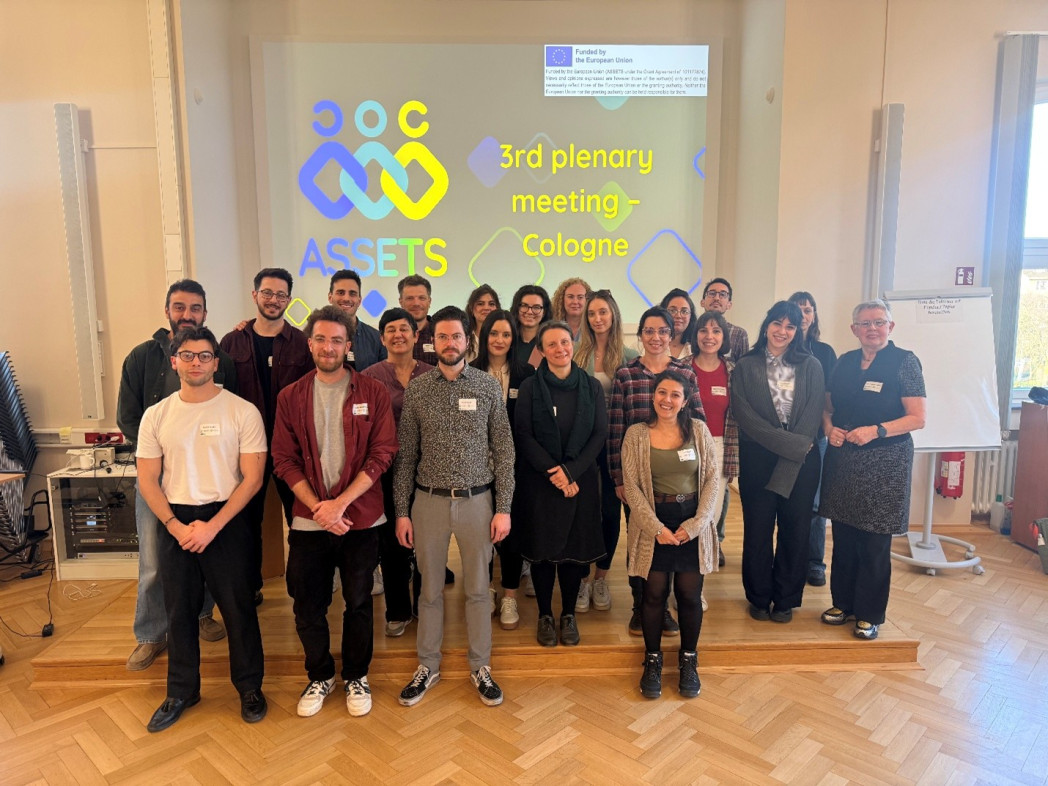
Rethinking Social Impact Assessment: Insights from the ASSETS General Assembly
Director Richard Lang and researcher Alessandra Piccoli participated in representation of the Competence Centre for the Management of Cooperatives. Over two days, project partners engaged in structured discussions focused on methodological progress, digital tool development, and preliminary findings emerging from pilot implementations across Europe. The meeting provided an important opportunity to consolidate ongoing work and strengthen the scientific grounding of the project’s interdisciplinary approach to social impact measurement.
A central component of the Cologne meeting was the dedicated workshop, “Rethinking Social Impact Measurement in the Social Economy Sector,” held on the 6th of March. The workshop addressed a pressing challenge in social economy research: the persistent misalignment between existing impact assessment frameworks and the lived realities of social economy organisations (SEOs). Traditional models, designed primarily for external accountability, tend to prioritise beneficiary outcomes while neglecting organisational dynamics, working conditions, and job quality—dimensions that are fundamental for understanding the actual social value produced by SEOs. Moreover, current assessment procedures often impose disproportionate administrative burdens and rarely accommodate local specificities or diverse organisational cultures.
Against this backdrop, the ASSETS project proposes a methodological reorientation. The workshop introduced the project’s integrated approach, combining qualitative and quantitative methodologies to capture multiple forms of value creation. Contributions by Alexandros Pazaitis on outcome mapping and qualitative impact processes, by Maria Vrachioli on cost–benefit analysis adapted to social economy contexts, and by Georgios Chatzichristos on the structural limitations of existing frameworks helped articulate the need for more inclusive and multi-dimensional assessment models. These interventions highlighted how theoretical innovation, when paired with practice-oriented tools, can address the conceptual gaps currently affecting measurement practices in the sector.
The workshop also showcased the first version of the ASSETS digital tool, including a mobile application and an AI-based chatbot designed to operationalise the project’s methodology. These digital instruments aim to support SEOs in conducting internal evaluations that are both rigorous and accessible, enabling them to assess outcomes related not only to beneficiaries but also to employees and organisational well-being. Their development marks a significant step toward reducing the administrative burden associated with impact assessment while increasing its analytical depth.
The session concluded with reflections from policy stakeholders and an open discussion with practitioners, who emphasised the need for scalable tools that can interface with emerging European and national strategies for the social economy. The dialogue underscored the potential of ASSETS to contribute to policy-oriented debates on decent work, digitalisation, and organisational sustainability, particularly at a moment when social economy organisations are playing an increasingly visible role in addressing socio-economic inequalities across Europe.
Overall, the Cologne meeting reinforced the scientific and societal relevance of the ASSETS project. By bringing together methodological innovation, digital experimentation, and participatory co-creation with social economy stakeholders, the project continues to advance a more comprehensive and context-sensitive understanding of social impact—one that moves beyond traditional reporting logics and recognises the complex interactions that shape value creation within the social economy.