Tenured full professors | History of Contemporary Art
Inge Hinterwaldner
Short bio
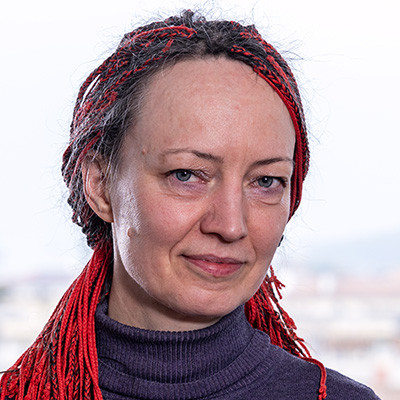
In 2009 Inge Hinterwaldner received her Ph.D in art history from the University of Basel with a thesis on interactive computer simulations (The Systemic Image, German: Fink 2010, English: MIT Press 2017). Fellowships and grants allowed her to pursue her research at MECS in Lueneburg (2014), Duke University in Durham (2015), and MIT in Cambridge/MA (2016). 2016-2018 she was Professor for Modern and Contemporary Art in the Department of Art and Visual History at the Humboldt University in Berlin. 2018-2026 she held a professorship for Art History at the Karlsruhe Institute of Technology in Karlsruhe, Germany. 2023-2024 she was Senior Fellow at Collegium Helveticum, ETH Zurich. Her research focuses on interactivity and temporality in the arts, computer-based art and architecture, tectonics of programmed art, image and model theory, expressiveness of fluid dynamics, and the interdependence between the arts and the sciences since the 19th century. In 2025 she co-curated the show “Choose Your Filter! Browser Art since the Beginnings of the World Wide Web” at ZKM | Center for Art and Media in Karlsruhe. She is PI of the ERC research group “Coded Secrets: Artistic Interventions Hidden in the Digital Fabric” (since 2022), dealing with the structure, concept, aesthetic and situatedness of net-based artworks from a variety of perspectives and disciplines.
Courses
Histories, Theories and Critical Interpretations of Art
47215 · ARTE-01/C · Master in Critical Creative Practices · EN
Research Focuses
Inge’s research focuses on technology-oriented forms of artistic expression dating back to the 1960s. This includes art and technology movements in Europe and the Americas, such as those operating under the labels ‘Arte Programmata’ or ‘New Tendencies/Nove Tendencije’. These initiatives and groups cover a broad spectrum of topics, ranging from formal experiments to political education. Artists work with state-of-the-art technological tools, scientific approaches and progressive social concepts. Consequently, art-historical research is also challenged, in the most positive sense, to transcend its disciplinary boundaries. It is an adventure to connect different fields and to work at the interface between art and science. Inge has focused in particular on the fields of ecological/ecocritical art, bio art, and works that draw on the visual languages of medicine or physics.
With her background in art history and image studies, she applies the same passion to exploring visual communication strategies across artistic, technical and scientific fields. In her doctoral thesis, Inge introduced the concept of the ‘systemic image’, which she used to describe the often underestimated role and power of visual renderings in interactive real-time simulations (such as computer games, training simulators or experiments in artificial life). She also analysed how computer simulations, as cybernetic calculations of processes, are ‘perspectival’, i.e. not all-encompassing: they depict phenomena specifically, according to a particular set of rules.
Digital, coded and network-based art constitutes an important field of research. This includes, for example, browser art, net art, satellite art and sky art. What sets Inge’s approach apart is her work within interdisciplinary contexts and her close reading of these phenomena on both aesthetic and technical levels. Here, academic analysis meets conservation concerns. Together with her research groups, she develops methods and publication formats that enable her to open the ‘black boxes’ and uncover further dimensions of complex artworks that are central to understanding the works. Her research in this area draws on code, software, game, and platform studies. She is currently developing an approach to modelling in art history.