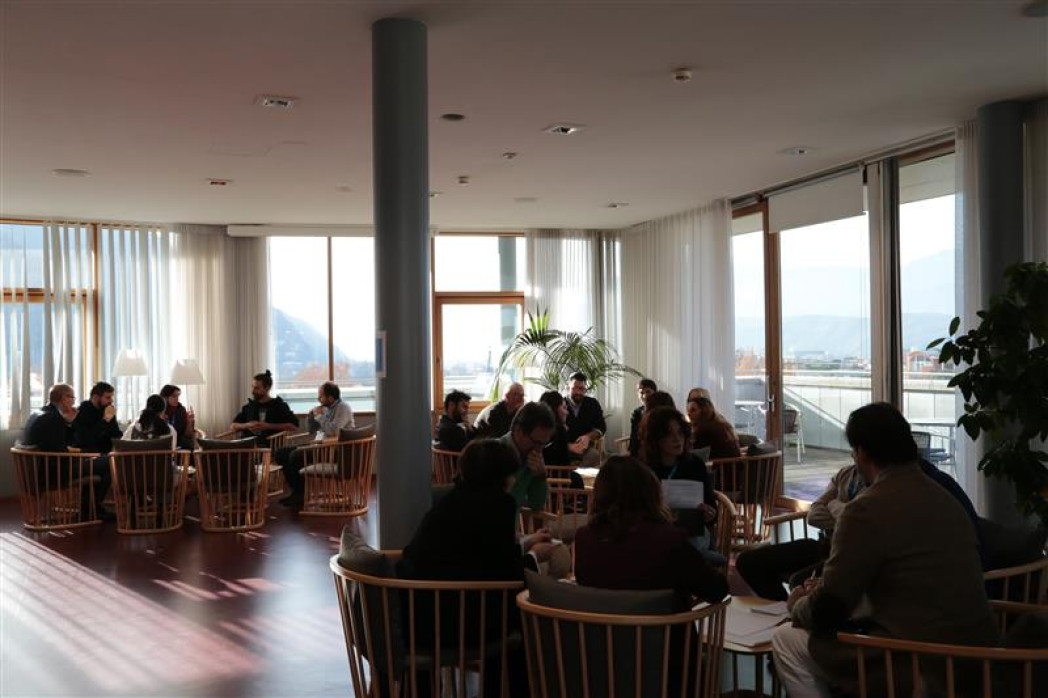
The morning brought together around thirty participants, including representatives of social cooperatives, researchers, professionals, and students, with the aim of initiating an informed discussion on the role of digitalisation in the third sector and reflecting on how the Centre can support the existing needs of the local area.
The opening keynote was delivered by Maurizio Busacca (Ca’ Foscari University of Venice), who provided a solid and articulate overview of the state of the art of digitalisation in the Italian third sector. In his presentation, ISTAT data and recent research challenge the still widespread narrative that non-profit organisations and social cooperatives are structurally “lagging behind” or culturally averse to digital technologies. On the contrary, empirical evidence shows that almost 80% of non-profit organisations use at least one digital technology, with adoption patterns very similar to those of SMEs.
The central issue, therefore, is not aversion to digital technologies, but a combination of structural factors: chronic underfunding, a lack of technical and managerial skills, and organisational fragility. In this context, digitalisation does not advance “by decree” but as an incremental process, often initiated from below thanks to the initiative of individuals who act as champions of change. Leadership, training, and enabling organisational conditions are thus decisive elements for transforming individual experimentation into shared practices.
The discussion was then enriched by presentations of concrete experiences from the region. Maria Susat and Tiziano Mazzurana (Novum2) showed how the introduction of digital tools can support not only management control, process monitoring, and quicker, data-driven decision-making, but also technologically intensive work-integration projects, such as the development of digital guides to support industrial assembly work. In collaboration with Luca Gualtieri from the Smart Mini Factory at unibz and within the framework of the “INCLU5ION” project, projected visual guidance systems were developed for people with cognitive or physical limitations. These systems guide users step by step through complex tasks (such as assembling pneumatic cylinders), increasing autonomy, productivity, and personal satisfaction.
Konrad Meßner then shared the experience of Kairos Digitale, offering a complementary perspective that understands digitalisation both as a market product—such as the dematerialisation of historical archives—and as a philosophical challenge. His contribution emphasised the importance of maintaining a human balance in an era dominated by speed and homogenisation, reminding us that work and culture sometimes require a reflective “distance” in order not to lose their soul. The session concluded with Giacomo Maestri (Nefeli), who interpreted the digital as an organisational culture. In line with Busacca’s opening keynote, Maestri stressed that introducing new tools is not sufficient if it is not accompanied by a change in language and collective behaviour: technology only works if it is consciously adopted by people, not imposed from above. From this perspective, digital processes become drivers of bureaucratic simplification—essential for freeing up valuable time to dedicate to relationships and social impact, which remain at the heart of the cooperative mission. Digitalisation thus amplifies the participatory DNA of cooperatives, reducing the distance between different sites and facilitating internal dialogue.
The participatory core of the morning was represented by the working groups, moderated by Giacomo Buzzao, Michela Giovannini, and Valentina Lovato, which highlighted needs, obstacles, and opportunities in three key areas: daily operations, external communication, and work integration. A detailed summary of the brainstorming activities can be found in the appendix.
Overall, it emerged that in the daily work of cooperatives, digitalisation is recognised as a potential lever for simplifying administrative tasks, data archiving, and planning, yet it encounters significant obstacles: lack of time for training, uneven digital skills, internal resistance, and difficulties in making the concrete benefits of technologies visible. At the same time, a strong demand surfaced for continuous training and long-term support, rather than one-off interventions.
In terms of communication, participants highlighted the lack of dedicated skills and resources for marketing and storytelling, while acknowledging the great potential of digital tools to increase the visibility of cooperative values, social impact, and services—also beyond the cooperative world. The challenge of building a coherent and shared identity remains one of the main open issues.
Reflections on the use of digital technologies for work integration were more nuanced. On the one hand, opportunities are emerging—for example in home automation and advanced social and health services—while on the other hand, digital technologies are still conceived mainly as managerial support tools rather than as levers for opening new markets or developing technologically intensive activities aimed at people in work integration.
The concluding visit to the BITZ unibz fablab, guided by Hannelore Schwabl, provided further insights into the potential of digital making as a space for learning, experimentation, and inclusion, reinforcing the idea that digitalisation is not only about technology, but about a set of social and organisational practices.
Overall, the day delivered a clear message: the digitalisation of social cooperatives is not a question of “if”, but of “how” and “under what conditions”. The role of the Competence Centre is therefore emerging as that of an actor capable of accompanying these processes, connecting research, practice, and the concrete needs of the local area.
Valuing and Networking Local Experiences
The discussions revealed strong heterogeneity: some cooperatives have developed advanced digital practices, while others are still in an embryonic phase. The Centre can play a key role in facilitating knowledge exchange, making local experiences visible, and fostering peer-to-peer learning.
This transversal networking approach also responds to the frequently mentioned issue of limited mutual awareness among cooperatives operating in the same territory, which rarely engage in dialogue on organisational matters.
Supporting Communication and Building a New Narrative
In terms of communication, the Centre can support social cooperatives in framing the right perspective to (re)construct a narrative that recognises their social and economic legitimacy. In this area, the Centre’s value lies not in replacing marketing functions, but in providing guidelines, shared formats, and moments of collective reflection on how digital tools can make social impact visible without distorting cooperative identity.
This narrative work is particularly important for addressing one of the structural challenges identified: the difficulty of attracting new skills and young professionals.
Interface Between Cooperatives, Institutions, and the Research World
Another strategic role of the Centre concerns institutional mediation. Many of the challenges that emerged in the working groups—from digital bureaucracy to top-down funding schemes and relations with public administration—cannot be solved at the level of individual cooperatives.
At the same time, the Centre can facilitate access to university and applied research expertise, turning digitalisation into a shared field of experimentation rather than an individual burden.
Insights from the Working Groups
Needs, barriers, and opportunities of digitalisation in social cooperatives
The working groups provided a particularly rich space for discussion, where the everyday experiences of cooperatives intertwined with reflections of an organisational and strategic nature. The discussion revolved around three main areas: daily operations, external communication, and work integration. In all three cases, digital technologies emerged not as an end in themselves, but as a potential lever whose effectiveness strongly depends on the organisational and cultural conditions in which they are introduced.
1. Operational management and work organisation (Daily operations)
With regard to day-to-day activities, participants acknowledged the significant potential of digitalisation to simplify administrative processes, improve data management, and support decision-making. However, this potential is often only partially realised.
The most frequently expressed need concerns staff training, particularly at middle-management level, where individuals are required to manage digital tools without having adequate skills or structured support. There was a strong call for continuous, long-term training pathways capable of accompanying the development of internal competences, thereby avoiding systematic dependence on external consultancy.
Alongside training, participants highlighted the need for reflective support, sometimes external to the organisation, enabling cooperatives to “look at themselves from the outside” and to understand how work processes could be rethought in light of available technologies. In many cases, the difficulty lies less in using the tools themselves than in imagining concrete applications that are coherent with existing activities.
The main obstacles identified include a widespread lack of digital skills, affecting not only administrative staff but also more operational roles, as well as the very limited time available for training, constrained by the urgencies of daily work. Added to this is resistance to change, linked both to the relatively high average age of staff and to the perception that technologies may complicate rather than simplify activities. It emerged that introducing tools in a non-mandatory way, initially as optional and accompanied by adequate transition periods, can help reduce such resistance.
On the opportunity side, participants referred to public funding available at the provincial level, considered relevant but often skewed towards the purchase of technologies rather than the financing of training and organisational support. Although funding dedicated to training does exist, access to it appears difficult: the effort required to prepare applications is perceived as disproportionate to the amounts available and to the resulting bureaucratic burden, sometimes triggering vicious cycles that bind together lack of time, inability to design projects, lack of funds, and insufficient training in causal loops that are difficult to escape.
Looking ahead, digitalisation is seen as an important lever to free up time from administrative work, allowing cooperatives to reinvest it in relational activities, service development, or innovation.
2. External communication and positioning
Communication emerged as one of the areas where the gap between potential and actual practices is most evident. Participants recognised the strategic role of digital communication in making visible the values, impact, and quality of the services provided, while at the same time highlighting widespread difficulties in investing systematically in this area.
A primary need concerns the presence of dedicated professional roles with skills in communication, marketing, and storytelling. Their absence is attributed both to resource constraints and to an organisational culture that tends to regard these functions as less of a priority compared to daily operations. As a result, communication is often fragmented, discontinuous, and entrusted to non-specialised internal competences.
Among the main obstacles is limited familiarity with digital communication tools, particularly social media, and the difficulty of building a coherent and shared identity. This problem is intertwined with a broader issue of positioning: being perceived as enterprises, as social cooperatives, or as both generates ambiguities that complicate the construction of an effective narrative.
Nevertheless, opportunities are seen as significant. Digital tools not only make it possible to expand external visibility, but also to strengthen internal communication across roles and productive sectors. Moreover, more structured communication is viewed as a lever to attract resources, build trust, and enhance transparency, by publicly taking responsibility for telling the story of cooperative action.
3. Work integration and digital technologies
The theme of work integration prompted more cautious reflections. In general, digitalisation is conceived primarily as a tool to support management activities (planning, monitoring, reporting), rather than as a lever for opening up new, highly technology-intensive areas of activity dedicated to people in work integration pathways.
One of the most significant obstacles concerns the difficulty of anticipating the profiles of people in work integration, often characterised by high turnover and heterogeneous skills. This makes it challenging to invest in specific technologies that may not be easily adaptable over time. In addition, in some sectors there is mistrust on the part of clients—particularly private individuals and families—towards digital services, due to concerns related to privacy and data protection.
Despite this, some emerging opportunities were identified, especially in the fields of home automation and socio-health services, where digital technologies can both improve service quality and open up new employment possibilities. However, these experiences remain sporadic and would require targeted support in order to be scaled up.
Cross-cutting considerations
Overall, the working groups portrayed digitalisation as a social and organisational process rather than a purely technological one. Cooperatives recognise the value of digital technologies, but experience their limits on a daily basis when time, skills, resources, and a shared vision are lacking. In this sense, the implicit request addressed to the Competence Centre is to play a structured accompanying role, capable of integrating training, consultancy, peer exchange, and the construction of a new narrative of social cooperation in the digital era.