L’era del disordine. Conflitto e cooperazione nel capitalismo contemporaneo
The conference brought together over seven hundred participants and featured forty-three thematic panels, moments of interdisciplinary dialogue, and three plenary sessions devoted to crucial issues such as social policies in times of war, the public dimension of economic sociology, and the transformation of the state within possible institutional reconfigurations aimed at understanding the ongoing changes in contemporary capitalism.
Within the program, the panel “Cooperation and Job Quality: Challenges, Opportunities and Ambivalences”, coordinated by Alessandra Piccoli and Marco Fama, provided an opportunity to reflect on the relationship between cooperative forms, working conditions, and alternative models of economic organization. The session explored the dual nature of cooperation, understood both as an institutional model and as a social practice oriented toward reciprocity, participation, and the development of individual and collective capabilities. It also highlighted how cooperatives—often presented in terms of social sustainability and strong territorial embeddedness—must confront structural constraints, internal contradictions, and tensions linked to market dynamics.
Among the contributions presented, Alessandra Piccoli’s paper examined the social economy in South Tyrol within the framework of the ASSETS project, focusing on the territorial, regulatory, and organizational dynamics shaping its development. Based on a mixed-methods approach combining statistical data and qualitative interviews, the research underscored the sector’s complexity, marked by a high degree of heterogeneity among actors, the need to strengthen institutional coordination, and the importance of dedicated professionalization and managerial training pathways. Within the project, the activities of the Competence Centre for Cooperative Management were also mentioned as an integral part of the support system aimed at enhancing sectoral qualification. In the context of the SISEC 2026 Conference, this perspective offered a privileged vantage point from which to consider how, in the “age of disorder,” cooperative practices can represent both a response to the pressures of contemporary capitalism and a laboratory for social experimentation capable of influencing future trajectories of economic and territorial development.
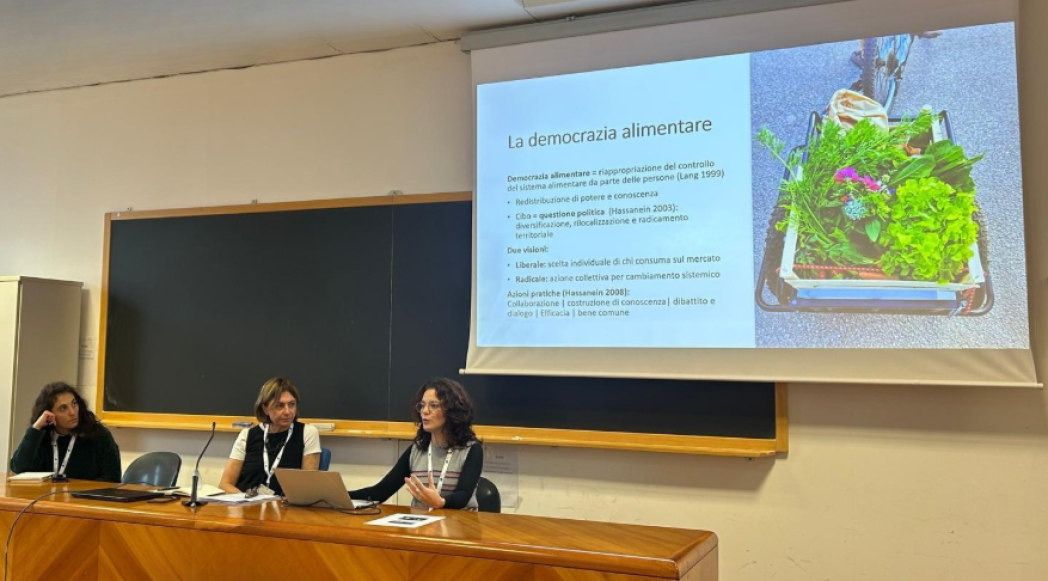
In the session “Fractures and Bonds: Collective Responses and Participatory Models in the Age of Disorder”, Michela Giovannini, researcher at the Competence Centre for Cooperative Management, presented a co-authored paper with Francesca Forno and Ewa Kopczyńska. The contribution, “Impacting Conventional Foodways with Food Democracy: Diverse Scaling Strategies in Alternative Food Networks,” analyzes the strategies through which alternative food networks influence conventional food systems, promoting practices of food democracy and processes of socio-economic transformation.
Within the same panel, the paper “The Evolution of Democratic Innovations: A Longitudinal Perspective on a Food Policy Council”, presented by Mattia Andreola and co-authored with Michela Giovannini and Francesca Forno, offered a longitudinal analysis of democratic innovation processes related to food governance, exploring the development and consolidation of participatory instruments in food policies.
Participation in the conference represented an important opportunity for scientific exchange on issues of participation, social innovation, and the transformation of food systems, in line with the research activities carried out by the Competence Centre.