The Prototyping Lab is a hands-on learning environment dedicated to modern manufacturing and product development. It integrates a wide range of technologies—from additive manufacturing (FDM, SLA, and composite 3D printing) to subtractive processes such as CNC milling and turning, as well as injection molding and laser cutting.
Equipped with industry-grade machines and professional tools, the lab allows students to move from digital design to physical prototypes, exploring the full product development cycle. Complementary systems for post-processing, assembly, and metrology support a comprehensive understanding of quality control and production workflows.
The lab is designed to support teaching, experimentation, and interdisciplinary projects, enabling students to develop practical skills in advanced manufacturing while fostering innovation and problem-solving.


Research topics
The Prototyping Lab’s research activities are strongly centered on additive manufacturing, with a particular focus on advanced 3D printing processes and their integration into modern product development. Current work explores multi-material FDM, high-resolution SLA printing, and continuous-fiber composite fabrication, enabling studies on lightweight structures, functional prototyping, and performance optimization. A key direction is the combination of design methods (e.g., topology optimization) with process parameters to improve mechanical properties, surface quality, and production efficiency. Looking ahead, the planned acquisition of a metal 3D printer will significantly expand the lab’s capabilities, opening new research opportunities in metal additive manufacturing, functional parts for engineering applications, and hybrid workflows that combine additive and subtractive techniques.
Equipment and technologies
| Category | Equipment | Key Specs (from slides) | Teaching Use |
|---|---|---|---|
| 3D Printing (FDM) | Ultimaker S7 + Material Station | 330×240×300 mm, dual extrusion, 6-spool system | Multi-material printing, workflow automation, industrial prototyping |
| Ultimaker S5 | 330×240×300 mm, dual extrusion | Reliable FDM basics, design iteration, student projects | |
| Bambu Lab PF003-M | 340×320×340 mm, 350°C nozzle, heated chamber | High-performance polymers, advanced process parameters | |
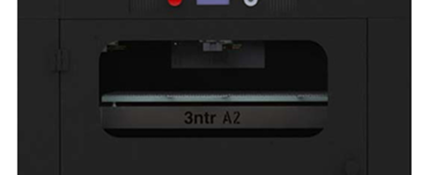
| 3NTR A2vs | 600×350×500 mm, 3 extruders, rubber printing | Large-scale prints, multi-material & flexible materials | |
| 3D Printing (Advanced) | Anisoprint Composer A3 | 460×297×210 mm, continuous fiber (carbon/basalt) | Composite manufacturing, lightweight structural design |
| Phrozen Sonic Mighty 14K (SLA) | 223×126×235 mm, high XY resolution, fast curing | High-detail parts, surface quality, resin technologies | |
| Post-processing | Phrozen Washing Station | 8L capacity | Cleaning SLA prints, post-processing workflow |
| Phrozen Curing Station | 405 nm UV, turntable | Polymer curing, material properties discussion | |
| Machining (Subtractive) | HAAS CM-1 Milling Machine | 305×254×305 mm, up to 30,000 rpm, WIPS probing | CNC machining, toolpaths, precision manufacturing |
| HAAS TL-1 Lathe | 1800 rpm, X: 203 mm, Z: 762 mm | Turning operations, rotational parts design | |
| Forming / Molding | Babyplast 10/25 Injection Machine | 16–24 cm³, up to 420°C, high pressure | Injection molding, mass production concepts |
| Drilling & Mechanical | Proxxon TBM 220 | Bench drill | Basic machining, manual operations |
| Optimum DX 17E | Bench drill | Precision drilling, workshop skills | |
| Assembly / Electronics | Weller PU 81 Welding Station | 150–450°C, 95W | Soldering, electronics assembly |
| Weller Shield Pro Vacuum | — | Fume extraction, safety practices | |
| Metrology | Coord3 Ares 755 CMM | 700×500×500 mm, high accuracy, Renishaw probes | Quality control, dimensional inspection |
| Cutting / Digital Fabrication | Worklinestore WL11045 Laser Cutter | (model unclear) | Laser cutting, 2D fabrication, rapid prototyping |
| Software / Simulation | Haas Control Simulator | CNC interface, programming tools | CNC programming, virtual machining training |
Main projects
The Prototyping Lab is currently engaged in a set of didactic projects alongside the development of a Learning Factory, both aimed at creating an integrated environment for teaching and experimentation in modern manufacturing. A central focus is the simulation of manufacturing processes using advanced techniques, including digital twins, process modeling, and data-driven analysis. These tools allow students and researchers to explore production scenarios virtually, optimize parameters, and understand the interaction between design, materials, and manufacturing constraints before physical implementation. By linking simulation with the lab’s fabrication capabilities, the Learning Factory supports a closed-loop approach where virtual models are validated through real production, fostering deeper insight into efficiency, quality, and innovation in manufacturing systems.
People
Laboratory Head: Walburga KerschbaumerTeam: Manfred Gius
Contact: walburga.kerschbaumer@unibz.it